Witness a divination — Anyang, c. 1250 BCE
Yinxu, royal precinct, reign of Wu Ding. A question is put to the ancestors.
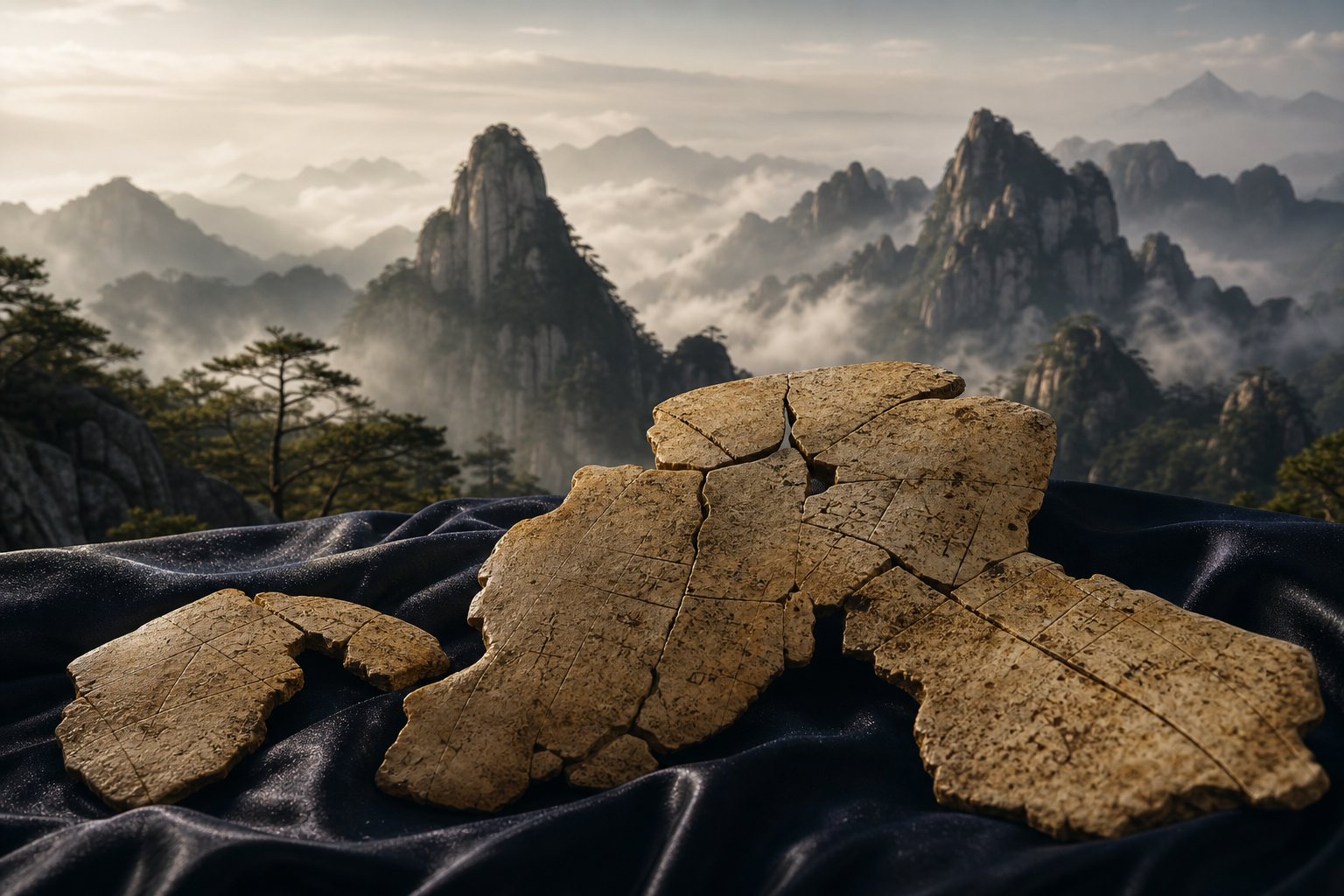
The bone is prepared
The bone must be made ready before the powers can be addressed. Ox scapulae and turtle plastrons are prepared for the rite — the surface through which the ancestors and Di, real and causally effective powers, will answer the court.
Keightley (1978): the inscriptions are divination records on prepared ox scapulae and turtle plastrons from the royal capital Yinxu (Anyang). An estimated 150,000+ inscribed fragments have been recovered — a systematic, large-scale corpus, but an exclusively royal one: it attests elite state religion, not what most Shang people practiced.
The charge is posed
Before the king, the diviner poses the charge in formal terms — “On day X, crack-making. The king should hunt at Y?” The matter is put directly to the ancestral powers, whose favor determines outcomes in war, harvest, weather, royal health, childbirth, and hunting.
Keightley: the formal charge structure provides dated, sequential records of royal religious activity. Historians read the procedure as a structured mechanism for decision under uncertainty (anxiety-reduction) and as divine authorization for collective royal action (cooperation-enforcement) — functions tagged in the vault's tradition profile.
Heat — and the crack
Heat is applied to the prepared bone until it cracks. The crack is the answer arriving: the inscriptions treat the cracks as divine responses to the charge that was posed. Divination, from inside the Shang ritual frame, is efficacious technology — not symbolic expression.
What survives is physical: burn and crack on bones recovered from stratified deposits at Yinxu, excavated systematically from 1928 onwards. Twenty-six bones from Wu Ding's reign are radiocarbon-dated to 1254–1197 BCE ±10 years (Zhichun Jing et al., Radiocarbon) — class 1-archaeology, independent of traditional Chinese chronology.
The king reads the crack
The crack is read as auspicious or inauspicious. Professional diviners (bu) execute the technical work, but the king is the ultimate divination authority — his unique ritual access to Di and the ancestors is the ontological basis of his right to rule.
Keightley and Eno: the king's exclusive ritual access grounded political authority — legitimation is the most clearly attested function across the corpus. What Di actually is remains genuinely contested: separate high deity (Keightley) or apex of the ancestral hierarchy (Eno)? The oracle-bone syntax cannot settle it (register Q25).
The record — and the verification
The divination is carved into the bone: the charge, the reading, and — sometimes — what really happened. The inscriptions are not records of something believed; they are records of something done: charges made, cracks read, outcomes noted.
The verification records are analytically decisive: they show a pragmatic, outcome-tracking relationship with the supernatural, not a purely symbolic or commemorative one. These inscriptions are simultaneously the earliest dated corpus of Chinese writing and the earliest direct textual evidence for Chinese religious practice.
The same bones, on black
Every caption on this page is verifiable against the inscriptions — that is why this ritual shipped first.
150,000+ inscribed fragments from Yinxu; 26 bones radiocarbon-dated to 1254–1197 BCE ±10 years. The earliest dated corpus of Chinese writing, and the earliest direct textual evidence for Chinese religious practice.
It is exclusively royal — commoner religion is an evidential blank (register B15) — and it covers only the last nine Shang kings, roughly the dynasty's final 200 years. “Earliest dated religious writing” does not mean earliest religion: the religion precedes the writing.
← all walkthroughs · the next three rituals open when their tier-1 gathering lands (register Q31–Q33)